Politics
Cook County Board of Review to Reopen 2025 Property Tax Appeals Window
After a four-month delay, many Cook County homeowners got an unpleasant surprise when their property tax bills arrived.
The median homeowner’s bill went up by a record-setting 16.7%. To help cope with what they call “unprecedented circumstances,” the Cook County Board of Review, the office tasked with settling appeals, announced that everyone who lives in a Cook County township that’s already closed its 2025 property tax appeal window will have another shot to file.
Part of the reason residential property taxes skyrocketed was the result of commercial properties, like real estate along the Magnificent Mile, losing value. A nearly $500 million tax burden was then shifted onto homeowners, according to a study from the Cook County Treasurer’s Office.
Rising residential assessments in South and West Side neighborhoods is a reflection of wealth creation in those communities, Cook County Assessor Fritz Kaegi told WTTW news last week. However, higher bills could accelerate gentrification, pushing long-standing residents out.
Samantha Steele, a Cook County Board of Review commissioner, said the county is in need of more physical inspections to determine what homeowners should pay.
“He doesn’t meet the national industry standard levels,” Steele said in reference to Kaegi. “Cook County has not had a physical inspection of properties since 1997. So you’re looking at close to 30 years of properties not having a physical inspection. When I say physical inspection, I mean the assessor’s office isn’t going out and looking at the overall appearance of your house.”
Kaegi has said the Board of Review sides more with commercial property owners in its appeals process.
“When we finished our reassessment of Chicago, homeowners would have had actually two percentage points less of the burden than they started with because we saw residential values going up, but we saw commercial values being higher than where they had been in the last reassessment, which was right after the pandemic,” Kaegi said last week. “But these values were cut at the Board of Review by nearly 20% for commercial properties, whereas only 1% for residential properties.”
One-third of the county appeals every year, said Steele.
Data from Steele’s office shows some communities, particularly on the northeast side of the county, file appeals somewhere between 53 to 92%. Other areas, she says, see closer to a 5% appeal rate.
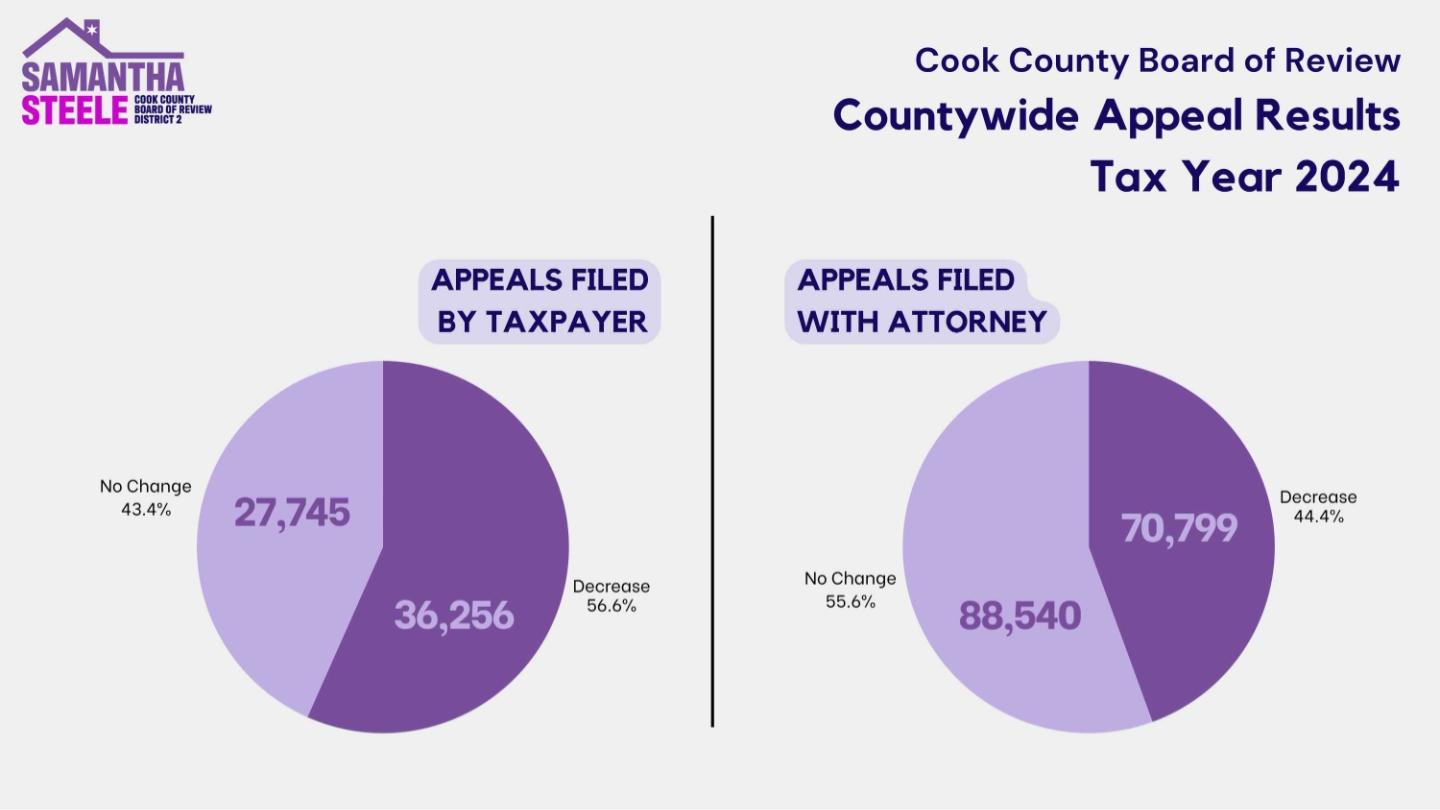
A little more than 56% of appeals filed by taxpayers in Cook County see a decrease, compared to 43.4% filing an appeal and seeing no change.
There’s a so-called circuit breaker bill that’s been introduced in the Illinois General Assembly, which looks to offer credits to homeowners who have seen bills increase by 25% or more year over year. It mirrors laws passed in 29 other states. Steele supports the measure, but asserts “we’re creating more Band-Aids for a sinking ship.”
Instead, to prevent the kind of sticker shock owners’ saw this year, Steele calls for modernizing the property tax system by incorporating physical inspection of properties and to re-delineate neighborhoods.
“I would strongly encourage taxpayers to look at their assessed value, look at their property record card, and make sure that it’s accurate,” said Steele. “Make sure that what the assessor has is reflective of what they actually have in their property. Make sure they’re getting their homeowner’s exemptions, their senior freeze, their veterans exemptions, or any exemption that they qualify for.”
The Board of Review is still working on a schedule to allow homeowners who have not already appealed to make their claim. A news release stated that those dates and filing instruction instructions will be announced in the coming days.